SKS
Classe inconnue
Dernière modification : 0.3.x · pas encore entièrement vérifiée · jeu actuel 0.5
- Calibre
- Cadence
- Inconnu
- Précision
- Inconnu
- Modes de tir
- Coup par coup
Pièces compatibles
Directement sur l’arme, puis à travers d’autres pièces (une lunette sur un montage sur la carcasse), jusqu’à trois étapes. Chaque pièce n’apparaît qu’une fois, par le chemin le plus court.
Visée
13 pièces- SKS Rear Iron SightHausse · indiqué sur une seule page
 503CU Micro SightViseur point rouge · sur High Sight Mount · indiqué sur une seule page
- Aimpoint ACRO P-2Viseur point rouge · sur Aimpoint Acro Picatinny Mount · indiqué sur une seule page
- Aimpoint Micro H-2Viseur point rouge · sur High Sight Mount
 Kaps Classic 4x36 OCLunette · sur Low Profile O-ring - 30mm
 Micro T-1 Red Dot SightViseur point rouge · sur High Sight Mount
- Micro T-2 Red Dot SightViseur point rouge · sur High Sight Mount
 RAZOR 1-10x Rifle ScopeLunette · sur O-ring - 34mm · indiqué sur une seule page
Afficher 5 de plusRéduire
Montage
12 piècesAfficher 4 de plusRéduire
Crosse
1 pièceChargeur
2 piècesAuxiliaire
1 pièceDescription
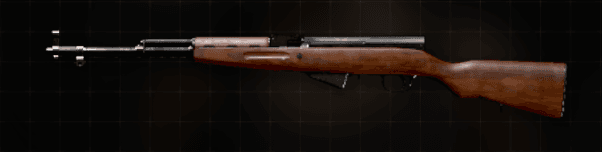
The SKS, originating in the Soviet Union, gained global prominence through widespread export and production. Notable for its fixed magazine and foldable bayonet, it lacked select-fire capability and had limited magazine capacity, leading to its replacement by the AK-47 in the Soviet Armed Forces during the 1950s. Despite this, the SKS continued to serve in various Soviet units for years. Soviet production occurred from 1949 to 1958 at the Tula Arsenal and from 1953 to 1954 at the Izhevsk Arsenal, resulting in approximately 2.7 million units. Additionally, millions more were produced under license in China and other Eastern Bloc countries during the Cold War. Its adaptability for guerilla warfare made it popular among insurgent forces worldwide. Since 1988, the SKS has been widely available in the civilian market in North America, maintaining popularity for hunting and sporting activities.Pas encore traduit, affiché en anglais
Valeurs à vérifier
Ces notes viennent de l’import des premières données. Elles disent pourquoi une valeur est vide ou douteuse (en anglais).
- class: not in the source wiki, left empty
- weight: not in the source wiki


